Michael Wallis
Creative Director / Founder
@08:00, 08.10.2026
Are you Trek or Wars?
Trekkies: mildly hippy optimists who believe in a post-scarcity world where a liberal Federation of Planets regularly blows the shit out of anyone who won't play nice.
Jedis: working-class escapists who dream of being swept away to a galaxy where they become super-powered, rescue a princess and blow the shit out of an oppressive Empire.
People fall into one camp or the other because both are brilliantly defined brands, built for different audiences. And that's the point of this piece. It doesn't matter which one you love. Both are masterclasses in building a brand universe, from mission to merch, and you can steal from either.
So let's score them. Twelve rounds, founder to theme park. One point per round, winner takes it. No draws, no mercy.
Lots of branding people are fond of science fiction, and I think it's because inventing a good universe is essentially a branding exercise. You need a founding idea, a mission, values, a look, a sound, products and places. Sci-fi just does it with spaceships.
Branding starts earlier than most people think. Before there's a logo, there's an investor saying yes or no. At that moment, the brand is the founder.
Trek: Gene Roddenberry. A former Pan Am pilot and LAPD press officer, he sold Star Trek to TV executives as "Wagon Train to the Stars", a Western in space. CBS heard the pitch and bought Lost in Space instead (TIME). The Western framing was a Trojan horse. His real model was Gulliver's Travels: social and political commentary disguised as adventure (Newsweek). He even got some of his ashes into orbit (StarTrek.com). Committed to the brand to the very end.
Wars: George Lucas. Coming off the hit American Graffiti, Lucas pitched Star Wars to Fox and then made the deal of the century. He took a reduced director's fee in exchange for sequel and merchandising rights (No Film School). Fox thought merch was worthless because its Doctor Dolittle merchandise push had flopped in 1967 (FunFactz). It became the foundation of Lucasfilm and a multi-billion-dollar business.
Brand lesson: Roddenberry shows how to translate a radical idea into language the buyer already understands. Lucas shows that the brand's business model is a design decision, made on day one.
Winner: Wars. Roddenberry got his show made. Lucas got to own the universe.
Score: Wars 1 – Trek 0
Trek has probably the most famous mission statement ever written: to boldly go where no one has gone before. It's in the opening titles of the show, every week. It tells you what the Enterprise does, why it exists and how it behaves: explore, don't conquer.
The Star Wars mission is to overthrow an oppressive Empire. That's less a mission, more a fight. It gives you a story, but not a purpose that outlives the story. Once the Empire falls, what are the Rebels for?
Brand lesson: a mission should be a direction of travel, not a single battle. You never finish going boldly.
Winner: Trek.
Score: Wars 1 – Trek 1
Trek does a great brand job of making the mission the tagline. It isn't Lovin' It or Think Different. It's going boldly. Rare discipline: one idea, used everywhere.
Star Wars wants the Force to be with you. Used throughout the films, it works as an in-universe version of "good luck". Then it escaped. Fans turned a pun into a date, and 4 May is now Star Wars Day, a global annual brand ritual the audience invented for free.
Brand lesson: the ultimate tagline is one your customers use without you. When people say it to each other, you've left advertising and entered culture.
Winner: Wars. Close, but "May the Force be with you" gets said at weddings, funerals and exams by people who've never seen the films.
Score: Wars 2 – Trek 1
This one goes deep. Both brands have done incredible work on iconography, environments, uniforms and product design.
Trek builds a system. Uniforms are colour-coded by function: command, science, operations. The delta badge works on a chest, a starship hull or a fan's lapel. The system is so legible it created its own idiom: don't be a red shirt. The bridge is a consistent environment you could draw from memory, and it's been redesigned for every generation without losing itself.
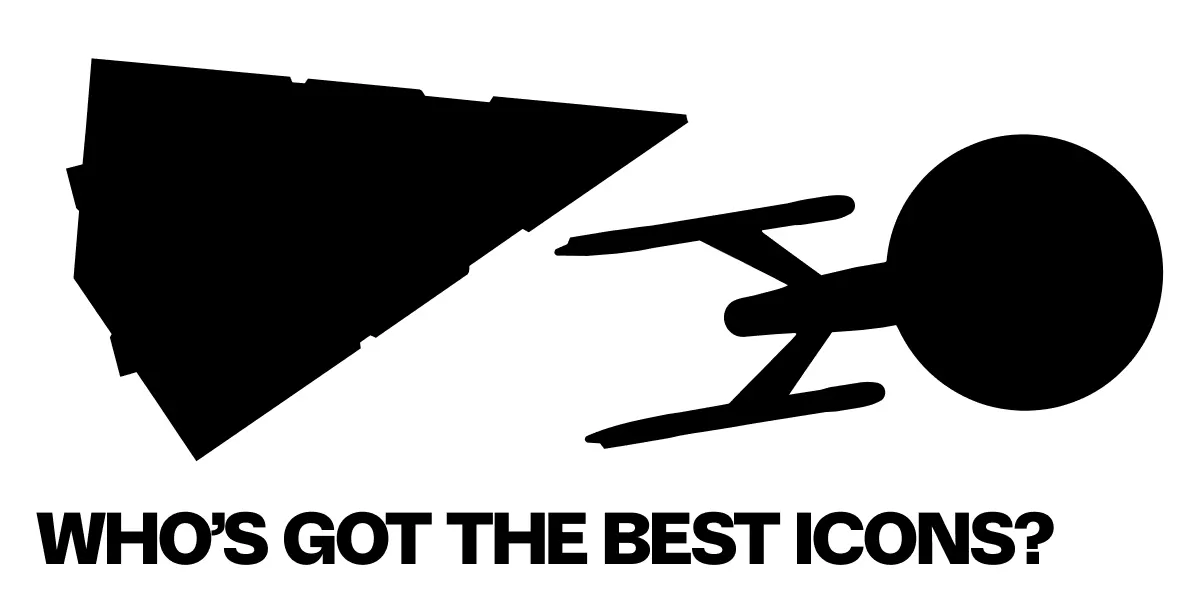
Wars builds icons. The Vader helmet. The X-wing. The TIE fighter. Stormtrooper armour. Ships named after letters: A, B, X, Y. The "used universe" look, dusty and dented, made the future feel lived in. Each is recognisable as a silhouette alone.
Brand lesson: icons get you noticed. A system lets you scale for 60 years, across 13 TV series, without a style guide falling apart.
Winner: Trek. Wars has the better individual icons, but Trek has the better identity system, and systems are what brand builders should be copying.
Score: Wars 2 – Trek 2
Trek doors go shhh shhh. The transporter shimmers. The communicator chirps. The red alert klaxon still makes fans sit up straight. Lovely stuff.
Wars has the lightsaber hum, Vader's breathing, R2-D2's beeps, Chewbacca's roar and the blasters going pew pew pew. Every major character has a sound signature you'd recognise with your eyes shut.
Brand lesson: sound is the most under-used brand asset. Wars proves it can carry character, threat and emotion without a single word.
Winner: Wars. Vader's breathing alone wins it.
Score: Wars 3 – Trek 2
Both have great scores. Trek has several memorable ones, from different films and series, and great work from several composers: Alexander Courage's original fanfare, Jerry Goldsmith's Motion Picture theme (which went on to open The Next Generation), James Horner's Wrath of Khan, Michael Giacchino's reboot.
But can they compare to John Williams? The original blast as the Star Wars logo fills the screen. The twin sunset as Luke looks out over the horizon. The Imperial March, literally hummed as the boss walks past your desk.
The critics agree. The American Film Institute named Star Wars the greatest American film score of all time (AFI), and the Library of Congress added it to the National Recording Registry (Wikipedia).
Brand lesson: give each character and idea its own musical theme and people will carry your brand in their heads. Williams built a brand system out of melodies.
Winner: Wars. Both great, but it's Williams' Wars work that takes it.
Score: Wars 4 – Trek 2
Wars has the lightsaber, the most desirable object in pop culture. Trek has the communicator, and the communicator changed actual products.
The story goes that Motorola's Martin Cooper was inspired by Kirk's communicator to build the first handheld mobile phone (BGR). Nerd honesty: Cooper later said his real inspiration was Dick Tracy's wrist radio (Euronews). But the flip-open Motorola StarTAC in 1996 looked so much like the communicator that the link stuck, and Motorola happily let it (Science Fiction Classics).
It goes further. Fans lobbied hard enough that NASA's first space shuttle test vehicle was named Enterprise (Encyclopedia.com). The tricorder has inspired real handheld diagnostic devices (Wikipedia). Trek imagined the tablet, the video call and the voice assistant decades early.
Brand lesson: a brand that paints a credible future becomes a brief for real inventors. That's influence you can't buy.
Winner: Trek. Nobody's built a working lightsaber. Everyone's carrying a communicator.
Score: Wars 4 – Trek 3
This is where the money starts talking.
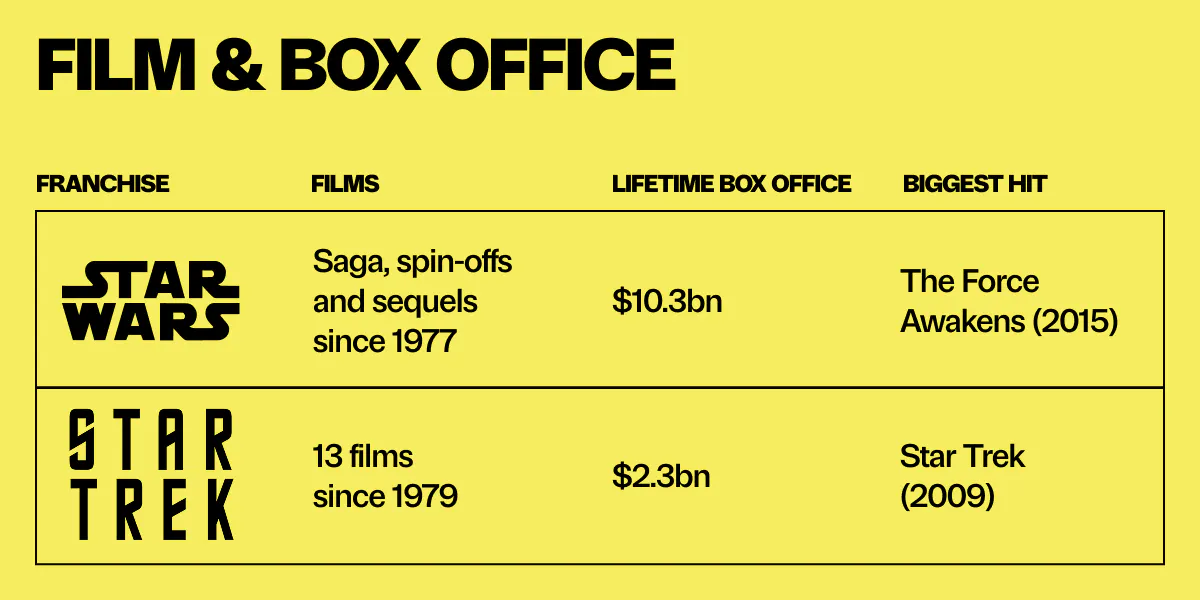
Figures: List of highest-grossing media franchises, Screen Rant, Star Trek (2009), Man of Many.
No Trek film has come close to $1bn (SlashFilm). Several Star Wars films have passed it. Trek was born on TV and the cinema was always a bit of a visitor; Wars was born as a cinematic event and still is one.
Brand lesson: know your native channel. Wars is a spectacle brand. Trek is a serial brand.
Winner: Wars. By about $8 billion.
Score: Wars 5 – Trek 3
Here Trek fights back hard. Thirteen TV series make up the franchise, The Original Series plus 12 spin-offs through to Starfleet Academy, totalling 970 episodes across 52 seasons (Wikipedia). The Next Generation, Deep Space Nine, Voyager, Lower Decks, Strange New Worlds: each a distinct sub-brand with its own crew, tone and audience, all clearly Trek.
Wars came to TV later but strongly under Disney, with The Mandalorian, Andor, Obi-Wan Kenobi, The Book of Boba Fett and Ahsoka (License Global). The Mandalorian also gave the world Grogu, a merch machine. But in franchise revenue terms TV is a rounding error for Wars at an estimated $280m, against $2.3bn for Trek (Wikipedia).
Not every launch lands. Starfleet Academy premiered in January 2026 and was cancelled within weeks, with season 2 its last (Variety). Brand architecture isn't immunity.
Brand lesson: Trek is the textbook on brand architecture. Same values, different crews, different tones: comedy, drama, animation, kids. That's how you stay relevant for 60 years.
Winner: Trek.
Score: Wars 5 – Trek 4
Here's the kicker. Not even close.
Star Wars has made an estimated $46.7bn. $29.1bn of that is merch. That's 62%.
Star Trek has made an estimated $11.2bn. $5.3bn of that is merch. About 47%.
Source: List of highest-grossing media franchises.
Star Wars makes nearly three times more from merchandise than from the films themselves. Toys were designed into the universe: ships you can hold, droids you can collect, weapons you can swing. Grogu has topped gift lists since 2019 (License Global).
Trek's universe is built on ideas, diplomacy and conversation. Brilliant television. Harder to put in a blister pack.
Brand lesson: if you want to sell products, design for ownership from the start. Lucas's 1976 contract and his toy-friendly universe were the same decision.
Winner: Wars. By about $24 billion.
Score: Wars 6 – Trek 4
Trek did it first. Star Trek: The Experience opened at the Las Vegas Hilton in January 1998: a $70m attraction with a Deep Space Nine-style promenade, Quark's Bar, and Klingon and Borg rides (Memory Alpha). Fans adored it. It closed in September 2008 on low admissions (Daily Star Trek News), months before the 2009 reboot brought in a new generation.
Wars went bigger. Galaxy's Edge opened at Disneyland in May 2019 and Disney's Hollywood Studios in August 2019 (Wikipedia). The Disneyland land alone covers 14 acres and cost an estimated $1bn (CNBC). Clever brand move: rather than recreate film sets, Disney invented a new planet, Batuu, so the story could keep growing (Under the Hard Hat). You can fly the Millennium Falcon, build your own lightsaber and drink in a cantina.
Brand lesson: an experience is the brand you can walk into. Build it as a new chapter of the story, not a museum of the old one.
Winner: Wars.
Score: Wars 7 – Trek 4
This is the round most people don't know about, and it's the most impressive thing in either universe. To make Star Wars, Lucas had to invent the tools. Those tools became companies.
Fox had no effects department, so Lucas built one. It's behind much of modern cinema. It's called Industrial Light & Magic (Looper).
In 1979 Lucasfilm set up a Graphics Group. Steve Jobs bought it. It made Toy Story. You know it as Pixar.
ILM's John Knoll and his brother Thomas co-created an image editor. Adobe licensed it in 1989. Now the entire design industry runs on it. It's called Photoshop.
For Return of the Jedi, Lucasfilm built a new sound standard. That was 1983. In 2002 it spun off. It's in cinemas and living rooms everywhere. It's called THX.
It's worth pausing on Photoshop. Without Star Wars, there's arguably no Photoshop, and without Photoshop the job of every designer reading this looks very different.
Trek inspired inventors (Round 7). Wars employed them.
Brand lesson: your capabilities can be a brand too. What you build to deliver your product might be worth more than the product.
Winner: Wars. Comfortably.
Score: Wars 8 – Trek 4
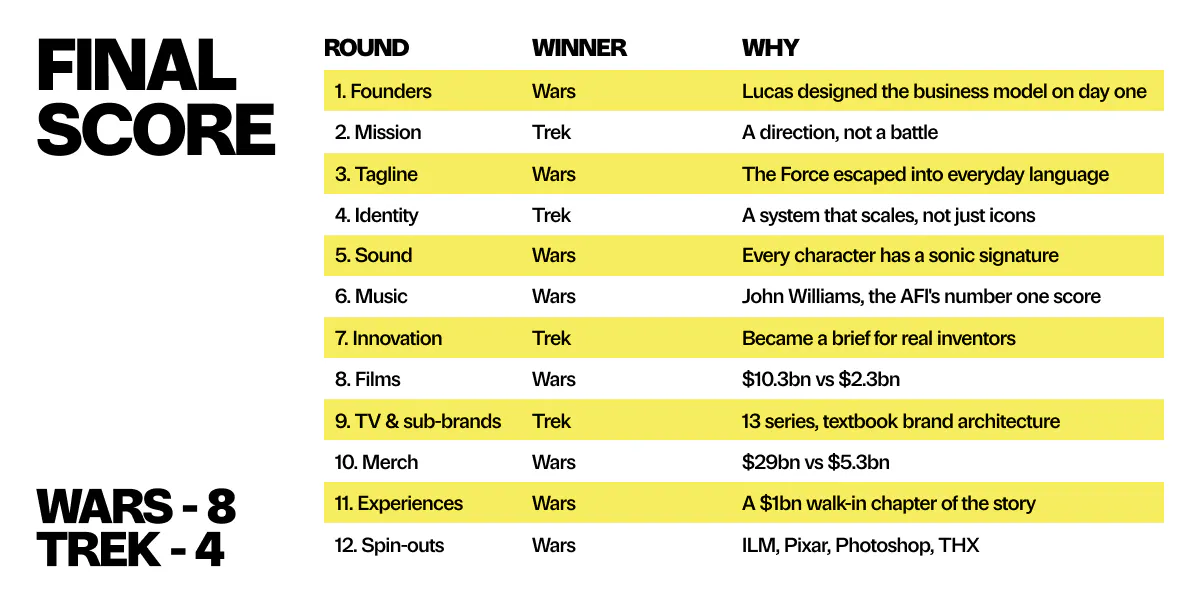
Look at the pattern. Trek wins on meaning: mission, system, ideas, longevity. Wars wins on monetisation: rights, products, places, capabilities. Trek is the better brand idea. Wars is the better brand business.
The real lesson is that you need both. A mission worth going boldly for, and a plan to own and monetise the universe you create.
Creating a brand isn't necessarily difficult. There are fantastic templates all around us. Trek or Wars, it doesn't matter which one you love. Choose one, study it from founder to theme park, and steal shamelessly.
I started out Star Wars, but now I live in North London among the liberal elite, I probably skew a bit more Trek than I used to. When I'm stuck, I still go to sci-fi. I greatly miss Iain M. Banks; his books about a futuristic Culture filled my head with ideas.
The problem with sci-fi is that when it's bad, it's the worst, so tread carefully. But if you need your head expanding a bit, pop down to Forbidden Planet and have a browse.
Just try to ignore the princesses clad in bikini armour riding dragons. That's FANTASY and should absolutely be avoided.
List of highest-grossing media franchises (franchise, merch, box office and TV revenue)
TIME: How Star Trek first made it to the screen
Newsweek: Wagon Train to the Stars
StarTrek.com: 10 things to know about Gene Roddenberry
No Film School: How George Lucas bet on himself
FunFactz: Lucas merchandising rights
BGR: Star Trek and the mobile phone
Euronews: Martin Cooper interview
Science Fiction Classics: Star Trek and the StarTAC
Encyclopedia.com: Gene Roddenberry
SlashFilm: Star Trek movies by box office
List of Star Trek television series
Variety: Starfleet Academy to end with season 2
License Global: Star Wars, the brand saga continues
Memory Alpha: Star Trek: The Experience
ILM: The Knoll brothers on Photoshop's origins