
7 Branding Mistakes That Quietly Kill Growth
Founder / Creative Director
@14:30, 26.01.2026

Most brands don’t lose momentum because of a single catastrophic decision.
They lose it because of small, repeated choices that feel sensible in the moment. Choices that make the website a bit clearer for internal teams, but less clear for buyers. Choices that make the message sound more professional, but less believable. Choices that make the brand easier to manage, but harder to remember.
And because these mistakes rarely show up as an obvious “brand problem”, they get misdiagnosed. The symptoms look like marketing underperforming, sales cycles stretching, price pressure increasing, recruitment getting harder or retention slipping.
If growth has started to feel heavier than it should, these are the seven branding mistakes worth checking first.

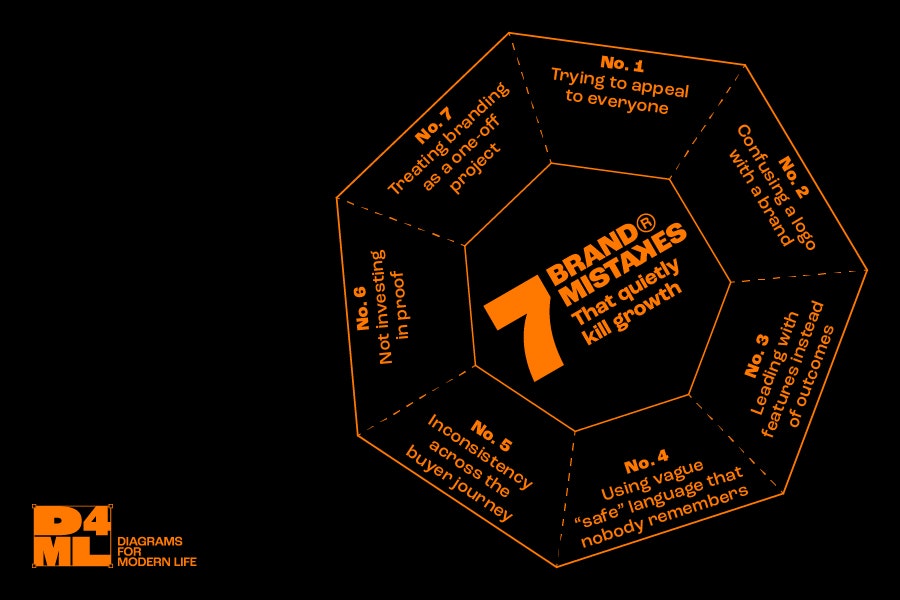
1. Trying to appeal to everyone
This is the most common “quiet killer” because it often comes from good intentions.
You want a bigger market, more inbound. You want to be flexible for different kinds of clients. So the messaging becomes broad: end-to-end, tailored, innovative, customer-centric. The pitch is that you can do anything for anyone.
The result is predictable: nobody feels like you are specifically for them.
Strong brands don’t narrow their capability. They narrow their relevance. They choose a clear audience and a clear set of problems they solve better than alternatives. That clarity gives people a reason to pick you now, rather than “add you to the list”.
What to do instead
Your brand should feel like it was built for someone. Define your primary buyer and primary use case. Have a human ambition in mind that you can help achieve: I want to be safer, recognised, more in control, a good parent, safer, faster, an explorer. The food industry talks about ‘owning a moment’.Then build your brand messages and materials, homepage, deck and sales narrative brutally specific to that scenario. You can still serve other audiences, but you need a point of excellence.
2. Confusing a logo with a brand
A refreshing identity can be genuinely valuable. Design matters. Consistency matters.
But visual identity is the wrapper, not the engine.
If the strategy underneath hasn’t been clarified, a new logo simply makes an unclear business look more polished while staying unclear. You might see a short-term uplift because things look “better”, but the core friction remains: buyers don’t quickly understand what you do, why it matters, and why you are the right choice.
That’s when teams start calling branding “subjective” or “fluffy”, because the visible work didn’t solve the invisible problems.
What to do instead
Before you touch visuals, lock down the fundamentals: positioning, proposition, proof, and tone. If you can’t write your value in two sentences without jargon, you’re not ready for a rebrand.
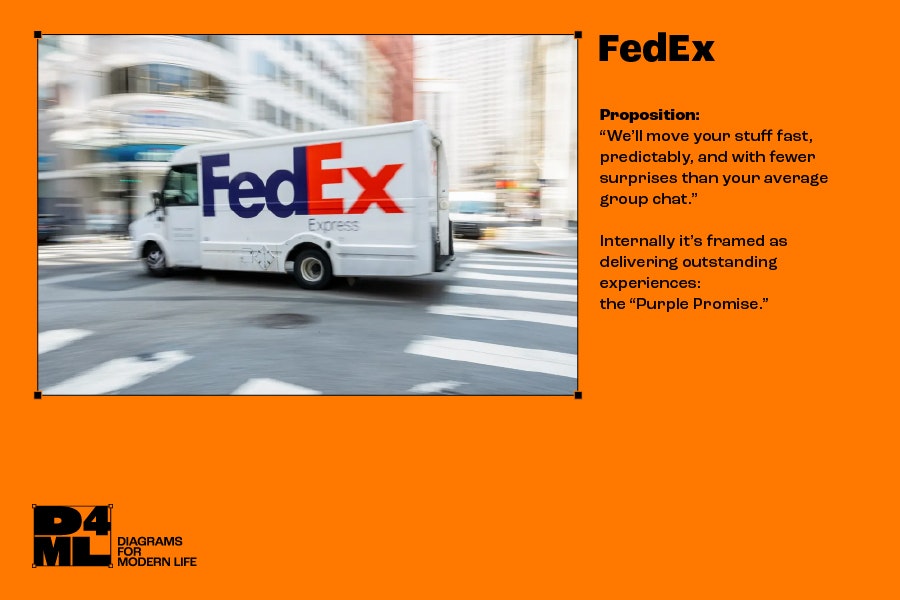
FedEx
Positioning
The grown-up in the room for shipping: global scale, serious reliability, and “we don’t mess about” operational discipline - for businesses (and humans) who can’t afford late.
Proposition
“We’ll move your stuff fast, predictably, and with fewer surprises than your average group chat.”
Internally it’s framed as delivering outstanding experiences - the “Purple Promise.”
Proof (things you can point at)
The Purple Promise is explicit: “I will make every FedEx experience outstanding.”
FedEx’s long-running People-Service-Profit culture and the Purple Promise show up in their corporate overview materials (i.e., it’s not just ad copy).
The Purple Promise is also referenced in public-facing policy/experience pages (it’s baked into how they talk about service).
Tone
Calm, competent, time-critical. Plain language. Fewer vibes, more verbs. If Patagonia is a campfire sermon, FedEx is a checklist and a barcode scanner.
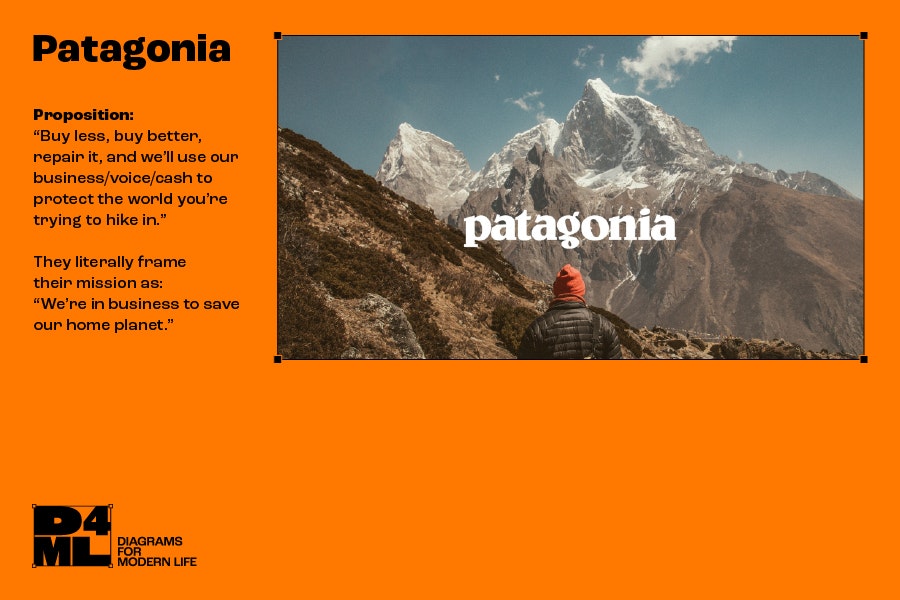
Patagonia
Positioning
Outdoor gear brand as environmental activist: make durable stuff, then use the business to fight the environmental crisis. “Planet first” isn’t a slogan - it’s the point.
Proposition
“Buy less, buy better, repair it, and we’ll use our business/voice/cash to protect the world you’re trying to hike in.”
They literally frame their mission as: “We’re in business to save our home planet.”
Proof (things you can point at)
Mission statement is unambiguous: “We’re in business to save our home planet.”
Ownership structure is designed to push profits toward fighting the environmental crisis (Purpose Trust + Holdfast Collective).
Ongoing commitment to give 1% of sales to environmental causes (longstanding and formalised).
3. Leading with features instead of outcomes
This one sneaks in through product, code or engineering pride.
You’ve built something impressive. You list the components, you explain how it works, you name the modules and the methodology. It’s accurate, and it’s true.
Your customers don’t care. At least, it’s not the thing that draws them in.
But most buyers aren’t trying to buy features. They’re trying to buy self actualisation.
B2B customers want fewer risks, faster deployment, reduced churn, fewer errors, a simpler workflow, better reporting, more predictable cost, less firefighting… and on and on. They want the after.
B2C customers want the thing that helps them become who they think they are - the brand that makes them attractive, wise, a homemaker, an artisan. People don’t buy mortgages, they buy the thing that gets them the key to the door of their new life.
When brands lead with features, they force the buyer to do the translation work. That translation takes effort, and kills conversion. So people bounce, stall, or ask for comparisons because they haven’t internalised value.
What to do instead
Rewrite your messaging in outcomes first, features second. A useful test: can someone explain the value to their boss after a quick skim? If not, you’re making the buyer work too hard.
4. Using vague “safe” language that nobody remembers
There is a particular kind of brand language that shows up everywhere:
Leading, innovative, trusted, solution, platform, world-class, seamless, robust
It sounds professional. It also sounds like everyone else.
Safe language feels lower risk because it won’t offend anyone internally. But it carries a hidden cost: it won’t differentiate you externally. And if you can’t be remembered, you can’t be recommended.
Most brands don’t need louder messaging. They need sharper messaging. Specificity is what makes a brand believable.
What to do instead
Replace generic claims with precise ones, and attach proof. Don’t say “high quality” - say what you do that produces quality. Don’t say “fast” - say what you’ve removed or streamlined. Don’t say “end-to-end” - describe the exact journey you support.
5. Inconsistency across the buyer journey
A common scenario:
- The website promises simplicity and confidence.
- The sales deck is technical and dense.
- The proposal reads like a legal document.
- Delivery feels different depending on who is involved.
- Customer success sounds like a separate company.
When the experience doesn’t match the promise, growth slows in quiet ways: referrals drop, expansion becomes harder and sales teams rely on discounts or relationships to close.
Brand isn’t a campaign - it’s a system. Buyers don’t experience your brand as “marketing” - they experience it as every interaction they have with you.
What to do instead
Audit the journey from first impression to renewal. Look for gaps between promises and reality. Then codify your message and approach in simple, usable assets: a one-page narrative, an objection-handling sheet, tone guidelines, and a minimum standard for proposals and onboarding.
6. Not investing in proof
Many brands have a strong claim and weak evidence.
They say they’re specialists, but don’t show their thinking. They say they’re trusted, but don’t show customers like the buyer. They say they deliver results, but don’t show outcomes. They say they’re different, but don’t prove it.
In competitive markets, the buyer’s default assumption is scepticism. Not because they’re cynical, but because they’ve been burned before. Proof reduces perceived risk. Without it, growth becomes dependent on persuasion rather than confidence.
Proof is not just testimonials. Proof is the substance that makes your positioning credible.
What to do instead
Build a proof library. Aim for a mix of:
- Before-and-after outcomes (even if qualitative)
- Examples and artefacts (screens, snippets, frameworks, working docs)
- Customer quotes tied to specific problems
- Third-party validation (partners, certifications, press, rankings)
- Your own original insight (research, benchmarks, learnings)
7. Treating branding as a one-off project
This mistake is subtle because it often comes after a big push.
A new identity launches, a new website goes live, a new deck gets made. Everyone breathes a sigh of relief and moves on. Branding gets put back in the drawer until the next big milestone.
But markets move. Competitors reposition, customer expectations evolve, your product expands, your team grows. Without ongoing stewardship, the brand drifts. Messaging becomes inconsistent, new pages get written in a different tone, sales builds their own story. The brand slowly fragments.
When you finally notice, the fix feels expensive because you’re untangling years of small deviations.
What to do instead
Treat the brand like a living operating system. Put light governance in place:
- Quarterly message check-ins (what are we hearing? What’s changed?)
- Content standards for new pages and decks
- A named owner for brand consistency
- Ongoing proof capture from projects and wins
A quick self-check
If you want a fast way to spot which mistake is hitting you hardest, ask these questions:
- Can a first-time visitor describe what you do in one sentence without guessing?
- Do your claims sound like yours, or like the category?
- Does your sales team tell the same story, or 5 different ones?
- Is your proof specific enough to reduce risk for a cautious buyer?
- Does the real experience consistently match the promise?
If you answered “no” more than once, the problem probably isn’t that your marketing needs more volume. It’s that your brand needs more clarity, specificity, and proof.
Growth rarely stalls because the market “doesn’t get it”.
It stalls because your brand quietly stopped making it easy for the right people to choose you.